Sustainable Expansion Starts Before Construction: Reducing Risk and Creating Value
Sustainable expansion starts before construction begins. Before solar panels, energy efficiency systems, or certifications, the sustainability of a real estate development is largely defined by the property itself: the land, warehouse, or commercial site that will become the operation.
These features remain relevant, but they do not, on their own, solve a poorly chosen site. A project may incorporate good technologies and still begin in a location that is incompatible with the activity, require excessive travel, face drainage issues, or depend on complex environmental interventions.
On the other hand, an early territorial assessment makes it possible to adapt the project, reduce risks, and find solutions that align operations, the city, and the environment. This is where real estate sustainability stops being just a feature of the build and starts guiding strategic decisions from the outset.
Real estate sustainability also means avoiding the wrong decision
Choosing a property without understanding its constraints can lead to delays, unplanned costs, and loss of value. That is why what to evaluate before choosing land for a development goes far beyond basic documentation.
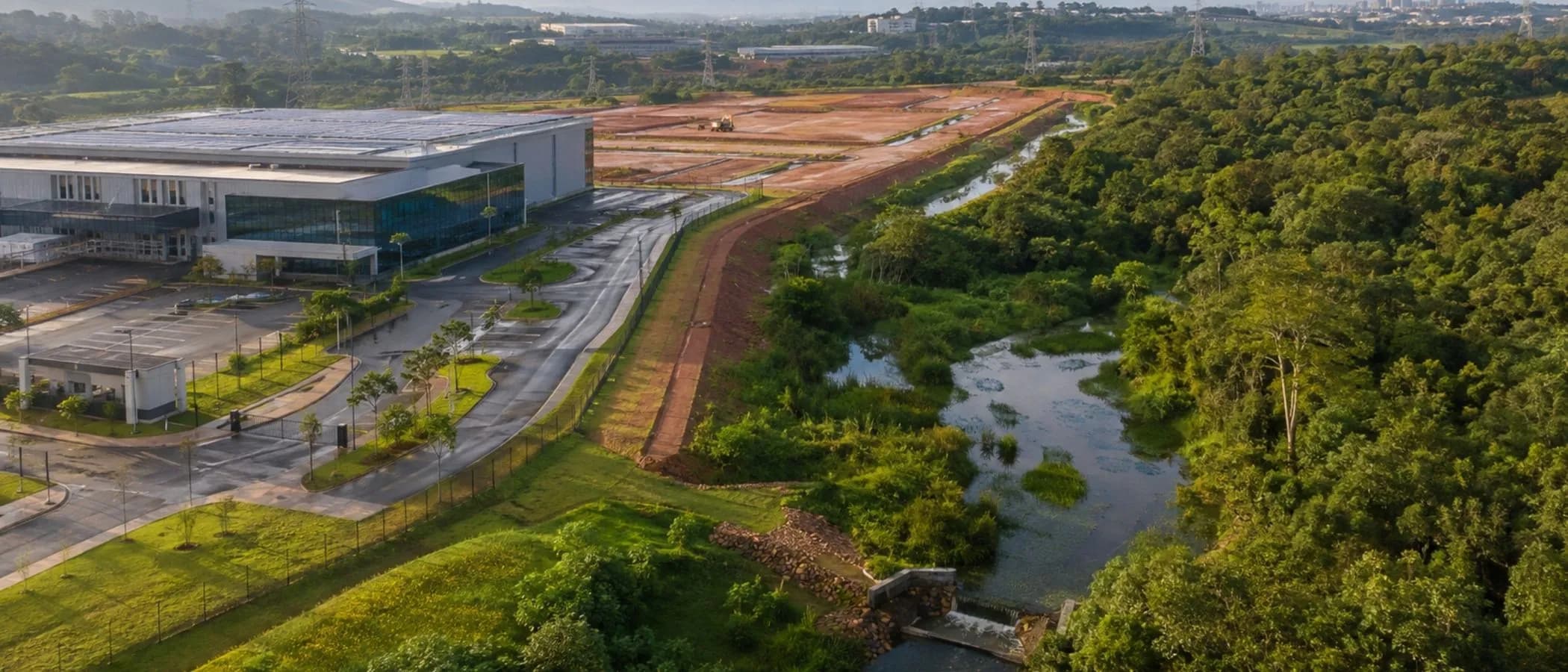
The preliminary analysis should also consider the site’s physical characteristics: topography, drainage, presence of waterways, vegetation, soil stability, access routes, neighboring properties, infrastructure, and permitted use. These factors directly affect the viability and quality of the real estate development.
These elements should not automatically be treated as obstacles. In many cases, they are design parameters. The key is to know early what needs to be preserved, mitigated, offset, licensed, or redesigned — and whether the timeline and investment still align with the company’s strategy.
Property choice, location, and efficiency in real estate expansion
The location must reduce inefficiencies
A well-located operation can shorten routes, improve supply, expand access to labor, and reduce time lost in transit. In practice, the choice of property directly affects operational efficiency and investment performance.
For retail and service networks, this involves proximity to customers and workforce mobility. For logistics and e-commerce, it involves access to routes, delivery windows, and vehicle circulation capacity.
Sustainability also depends on operational efficiency
Sustainability, therefore, is also tied to operational efficiency. A property that avoids unnecessary mileage, uses existing infrastructure, and allows for a coherent development can generate economic and environmental benefits at the same time.
From this perspective, sustainable expansion and real estate expansion go hand in hand when the location reduces waste, avoids rework, and improves the relationship between operations and territory.
Environmental permitting must be part of the strategic timeline
Environmental permitting, when applicable, defines conditions, restrictions, and control measures for the location, installation, and operation of projects. The need for it, the responsible agency, and the type of study depend on the activity, size, impact, and current legislation.
For this reason, the assessment must be carried out by qualified professionals and together with the competent authorities. Understanding how environmental permitting affects property selection is essential to avoid decisions that seem quick at first but prove slower, more expensive, or more complex throughout the development process.
The mistake is treating this stage as a formality after the property has already been chosen. When the issue enters planning early, the company can compare location alternatives, estimate timelines, allocate budget, adjust the design, and negotiate responsibilities with greater confidence.
In other words, how to reduce risks in sustainable expansion necessarily involves incorporating permitting into the strategic timeline from the beginning, not only once the decision has already been made.
Seven points for a more responsible real estate development
When structuring a real estate development with greater territorial, environmental, and operational security, some criteria deserve attention from the initial assessment stage onward.
- Use compatibility: confirm zoning, urban planning parameters, and activity-specific requirements.
- Environmental review: identify protected areas, water resources, vegetation, liabilities, and known constraints.
- Drainage and soil: assess topography, water runoff, stability, and the need for earthmoving.
- Mobility and surroundings: plan access, loading and unloading, noise, operating hours, and relationships with the neighborhood.
- Efficient infrastructure: size energy, water, sewage, data, lighting, ventilation, and resource reuse where feasible.
- Future flexibility: design spaces that can grow, change use, or receive new technologies with less waste.
- Document governance: record studies, permits, conditions, responsible parties, deadlines, and compliance evidence.
These points help guide property selection and give consistency to the decision-making process. They also strengthen a practical view of how to create value in real estate expansion with sustainability, connecting technical analysis, operations, and adaptability.
Green areas can be part of the value strategy
In certain projects, preservation, restoration, environmental compensation, and nature-based solutions may be part of the equation. These measures must comply with applicable legislation and technical guidance, but they should not be seen only as a cost.
When properly structured, they can improve drainage, thermal comfort, landscape quality, community relations, and the overall quality of the development. In this context, green areas cease to be merely an occasional requirement and become part of a concrete value-generation strategy.
The integration between real estate expansion and environmental expertise is especially important in areas with watersheds, significant vegetation, or strong urban pressure. Hasty decisions increase risk; informed decisions turn constraints into design.
Expanding responsibly protects business continuity
A new unit does not end when construction is delivered. It must operate, maintain permits, respond to requirements, coexist with its surroundings, and preserve its ability to adapt. The most valuable sustainability is the kind that remains embedded in daily operations and reduces future vulnerabilities.
Porta Nova brings together real estate experience, territorial expertise, and work with green areas to support a more complete view of development. That means selecting opportunities, recognizing limitations, and involving the necessary specialists before the company takes on commitments that are difficult to reverse.
Growing sustainably does not mean giving up speed. It means preventing today’s rush from becoming tomorrow’s cost.
Is your company looking for land, warehouses, or properties to grow with territorial and environmental security? Contact Porta Nova Expansão and share the project criteria.